

Shipping valuable or fragile items can be nerve-wracking. Cardboard boxes, while convenient, often fail to provide the robust protection needed for heavy machinery, delicate artwork, or long-distance freight. When standard packaging options fall short, building a custom wooden shipping box is the most reliable solution.

This guide on how to build a wooden shipping box will walk you through the entire process of constructing a sturdy, professional-grade wooden crate.
Whether you are a business owner shipping products or a DIY enthusiast moving personal items, you will learn how to build a container that can withstand the rigors of transit.
What Will You Need?
Before you begin, gather the necessary materials and tools. Having everything ready will make the construction process smooth and efficient.
Materials:
- Plywood: 1/4 inch to 3/4 inch thickness, depending on the weight of your item.
- Lumber: 1×4 or 2×4 framing lumber (pine or fir is standard) for structural support.
- Wood Glue: High-quality carpenter’s glue for added strength.
- Fasteners: 1 1/2 inch and 2 1/2 inch wood screws (avoid nails if you want to disassemble it later).
- Pallet Base (Optional): If the item is very heavy, you may want to build your crate on top of a standard pallet.
Tools:
- Tape Measure: For precise measurements.
- Circular Saw or Table Saw: To cut plywood sheets and lumber.
- Power Drill/Driver: For driving screws efficiently.
- Safety Gear: Safety glasses and work gloves.
- Pencil: For marking cuts.
- Square: To ensure your corners are 90 degrees.
10 Easy Steps on How to Build a Wooden Shipping Box
Step 1: Measure Your Item and Determine Clearance
The first and most critical step is getting accurate measurements of the object you intend to ship. Measure the height, width, and depth of the item at its widest points. Do not just measure the main body; account for protruding knobs, handles, or feet.
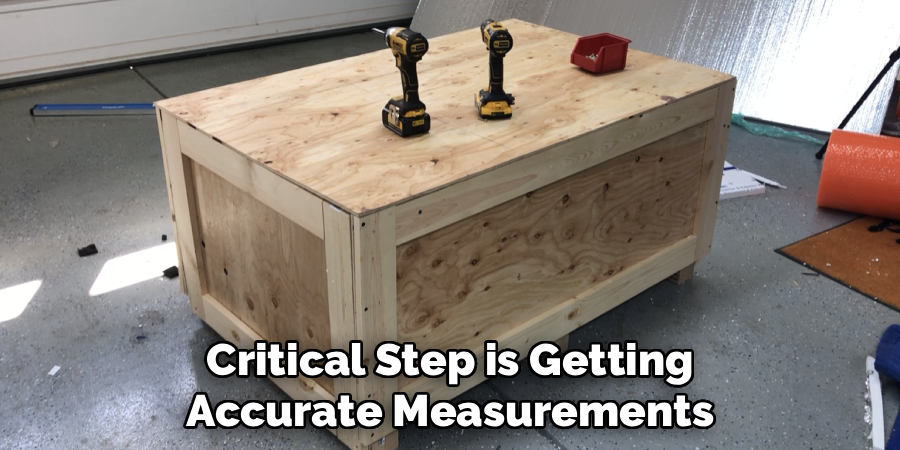
Once you have the raw dimensions of the object, you must calculate the clearance. You never want the item touching the wood directly. Add at least two to three inches to every dimension. This extra space will accommodate foam padding, bubble wrap, or other cushioning materials that absorb shock during transit. If the item is exceptionally heavy or fragile, increase this clearance to four inches to allow for thicker, denser foam. Write these final dimensions down clearly; they are the interior dimensions of your crate.
Step 2: Plan Your Cut List and Design
Before you make a single cut, you need a plan. Visualize the crate as six separate panels: a base, a top, two long sides, and two short ends (headers). Based on the interior dimensions you calculated in Step 1, determine the size of the plywood panels you need. Remember to account for the thickness of the plywood itself when calculating the outer dimensions.
For example, if your base is 24 inches wide and you attach side panels on top of the base, the side panels usually sit flush with the edge. Creating a written “cut list” prevents mistakes and wasted lumber. Decide now if you are using 2x4s or 1x4s for the framing cleats. Heavier items require 2×4 framing for rigidity, while lighter items can be safely shipped with 1×4 cleats to save on shipping weight.
Step 3: Cut the Base and Install Skids
Start construction at the bottom. Cut your plywood base to the required dimensions using your circular saw. Once the panel is cut, you need to elevate it off the ground to allow a forklift or pallet jack to lift it. Cut two or three pieces of 2×4 lumber to run the full length of the base. These are called “skids.”
Attach these skids to the underside of the plywood base using wood glue and screws. Drive the screws through the plywood and into the 2x4s from the top to ensure a secure hold. If the crate is wide, add a third skid in the center for support. This elevation is crucial for handling; without it, moving a heavy crate is nearly impossible.
Step 4: Build the Internal Frame for the Base
With the skids attached underneath, flip the base over so the plywood surface is facing up. You now need to frame the perimeter of the base to give the walls something to attach to. Cut lengths of your framing lumber (1×4 or 2×4) to fit around the edges of the plywood base.

Apply a bead of wood glue to the bottom of these frame pieces and screw them into the plywood base. Ensure they are flush with the edges. This creates a solid “rim” around your base. This rim serves two purposes: it reinforces the floor of the crate to prevent sagging, and it provides a wide, solid surface for you to screw the side walls into later.
Step 5: Cut and Frame the Side Walls
Now, move on to the vertical walls. Cut two plywood sheets for the longer sides of your crate. The height should match your desired internal height plus the thickness of the top and bottom frames. Like the base, these plywood sheets need framing for strength.
Cut vertical cleats (lumber supports) to attach to the vertical edges of these plywood panels. You may also want a horizontal rail across the middle if the crate is very tall. Glue and screw the framing lumber onto the plywood.
Step 6: Cut and Frame the End Panels
Similar to Step 5, cut the plywood for the two shorter ends (the headers) of the box. Frame these panels vertically with your lumber. The key here is to ensure the framing on these end panels interacts correctly with the framing on the side panels. Usually, you want the side panels to overlap the end panels (or vice versa) so that when you screw the corners together, you are screwing through plywood into solid lumber, not just into the edge of another plywood sheet.
Step 7: Assemble the Walls to the Base
With all four wall panels built, it is time for assembly. This is often easier with a helper. Place one of the long side panels onto the base. The bottom of the wall panel should rest on the base (or beside it, depending on your design), and you will screw it into the base frame you built in Step 4. Use 2 1/2 inch screws for this structural connection.
Do not fully tighten every screw yet. Position the adjacent end panel and screw it into the base and then into the side panel at the corner. Continue this process around the crate until all four walls are standing and secured to the base and to each other. Now, tighten all screws firmly. You should now have an open-topped box.

Step 8: Load and Secure the Item
Do not attach the lid yet! Now is the time to load your item. Place a layer of bottom cushioning (foam or bubble wrap) on the floor of the crate. Carefully lower your item onto this bedding. Once the item is inside, fill the remaining void spaces with your chosen packing material.
The goal is immobilization. If the item can shift, it can break. For heavy machinery, you might need to use wooden blocking or bracing screwed directly into the floor of the crate to lock the item’s feet in place.
Step 9: Construct and Attach the Lid
Measure the top opening of your assembled crate. Cut a final piece of plywood to fit this opening exactly. Like the other panels, the lid needs framing to prevent it from sagging or caving in if something is stacked on top of it.
Attach framing lumber to the underside of the lid plywood, positioned so that it fits inside the walls of the crate, or frame the top perimeter of the lid so it sits flush with the walls. A common method is to simply lay the plywood flat over the top walls and screw it down, but reinforcing it with cross-bracing is safer for shipping. Screw the lid down securely.
Step 10: Label and Final Inspection
The construction is complete, but the job isn’t done until the box is ready for the carrier. Inspect the crate for any protruding screws that could injure a handler or snag on other freight. Sand down any rough splinters on the corners. clearly mark the crate with “FRAGILE,” “THIS SIDE UP,” and “HANDLE WITH CARE” using stencils or spray paint.
Affix your shipping labels clearly on the top and at least one side. If the wood is untreated and you are shipping internationally, ensure you are compliant with ISPM-15 regulations (which require heat-treated wood) and stamp the crate accordingly. Your custom wooden shipping box is now ready for pickup.
5 Things You Should Avoid
Building a crate seems straightforward, but small errors can lead to catastrophic failure during transit. Avoid these common pitfalls to ensure your shipment arrives safely.
- Using Untreated Wood for International Shipments: If you are shipping across borders, you cannot use raw lumber from the hardware store. Most countries enforce ISPM-15 regulations, which require wood packaging to be heat-treated and stamped to prevent the spread of pests. If you use non-compliant wood, customs will likely reject, destroy, or fumigate your shipment at your expense.
- Neglecting Cross-Bracing on Large Crates: Plywood is strong, but large flat panels can wobble or “rack” (twist out of square) under heavy loads. If your crate is large, failing to add diagonal cross-bracing to the walls creates a weak structure. A diagonal brace adds immense rigidity and prevents the box from collapsing if it is dropped on a corner.
- Screwing into End Grain: This is a classic carpentry mistake. Screws hold very poorly when driven into the end grain of a board (the cut end). They can easily pull out under stress. Always design your crate so that screws are driven across the grain (into the side of the board) or use metal corner brackets to reinforce joints where end-grain connections are unavoidable.
- Ignoring Weight Distribution: Don’t just place a heavy item in the center of a thin plywood floor. If the item has small feet or a small footprint, the point load can punch right through the floor during a bumpy ride. Distribute the weight by placing the item on a larger piece of wood or thick plywood inside the crate to spread the load over the skids.
- Sealing the Crate with Glue Only: Never rely solely on wood glue for a shipping crate. While glue is strong, different climates, humidity levels, and the vibrations of a truck or airplane can cause glue joints to fail. Always use mechanical fasteners (screws) in conjunction with glue. Furthermore, never glue the lid shut; the recipient will have to destroy the box to open it, potentially damaging the contents.

Conclusion
Building your own wooden shipping box is an investment in peace of mind. While it requires more effort than grabbing a cardboard box off the shelf, the superior protection, security, and durability it provides are unmatched.
By following these steps on how to build a wooden shipping box—measuring accurately, framing correctly, and avoiding common structural mistakes—you ensure that your valuable items withstand the journey, no matter the distance.
With the right materials and a little patience, you can construct professional-grade packaging that rivals any commercial crate.

About
Mike May is a distinguished figure in the world of woodworking and timber design, with a decade of expertise creating innovative and sustainable indoor solutions. His professional focus lies in merging traditional craftsmanship with modern manufacturing techniques, fostering designs that are both practical and environmentally conscious. As the author of Woodimber, Mike delves into the art and science of timber-craft, inspiring artisans and industry professionals alike.
Education
RMIT University (Melbourne, Australia)
-
Associate Degree in Design (Timber): Focus on sustainable design, industry-driven projects, and practical craftsmanship.
-
Gained hands-on experience with traditional and digital manufacturing tools, such as CAD and CNC software.
Nottingham Trent University (United Kingdom)
-
Bachelor’s in Woodworking and Product Design (Honors): Specialized in product design with a focus on blending creativity with production techniques.
-
Participated in industry projects, working with companies like John Lewis and Vitsoe to gain real-world insights.
Publications and Impact
In Woodimber, May shares his insights on timber design processes, materials, and strategies for efficient production. His writing bridges the gap between artisan knowledge and modern industry needs, making it a must-read for both budding designers and seasoned professionals.