

Welcome the holiday season with a unique and personal touch by creating your own wooden Christmas tree. This rewarding DIY project offers a rustic, minimalist alternative to traditional firs and pines.
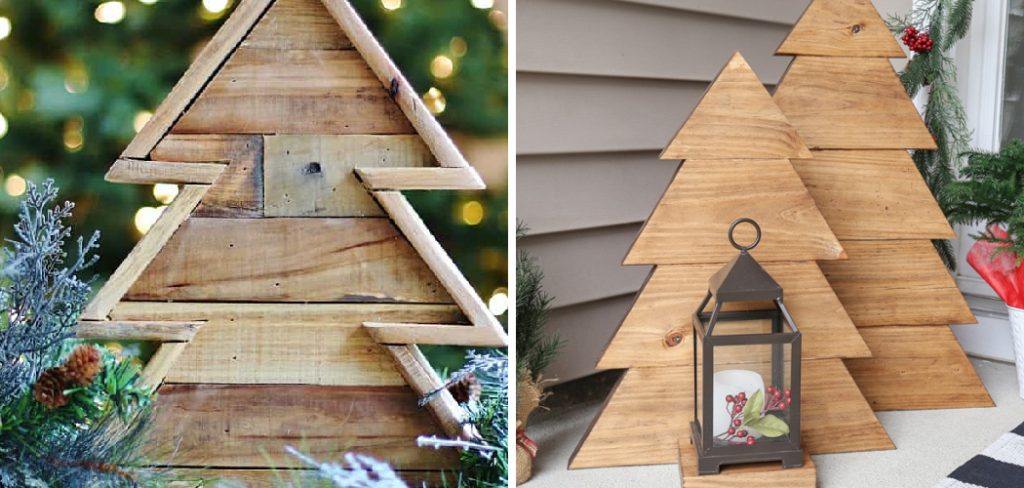
Whether you’re an experienced woodworker or a beginner looking for a festive challenge, this guide will walk you through every step. Crafting your own decorations adds a layer of meaning to the holidays, and this wooden tree is destined to become a cherished part of your family’s traditions for years to come.
Let’s dive into how to make wooden christmas trees.
What Will You Need?
Before you begin, gather the following materials and tools to ensure a smooth crafting process.
Materials:
- One 1×4-inch timber board (8 feet long)
- One 1×2-inch timber board (6 feet long)
- A wooden dowel (1/2 inch diameter, 3 feet long)
- A small wooden block for the base (e.g., a 4×4 inch post cut to 3 inches high)
- Wood glue
- Sandpaper (medium and fine grit)
- Wood screws (1.25 inches)
- Your choice of paint, wood stain, or sealer
- Optional: Wood star or other tree topper
Tools:
- Tape measure
- Pencil
- Miter saw, or hand saw with a miter box
- Drill with various bit sizes (including a 1/2 inch bit for the dowel)
- Clamps
- Safety glasses
- Dust mask
- Paintbrushes or rags for finishing
10 Easy Steps on How to Make Wooden Christmas Trees
This detailed guide breaks down the project into simple, manageable stages. Take your time with each step to ensure a beautiful and sturdy result.
Step 1: Measure and Mark Your Branches
The first step is to create the branches of your tree. You will use the 1×4 inch timber board for this. The key is to cut pieces of increasing length to create the classic triangular tree shape. Start by deciding on the width of your widest, bottom branch.
A good starting point is 24 inches. From there, you will cut subsequent branches, each slightly shorter than the last. For a well-proportioned tree, aim to decrease the length of each branch by about 2 inches.

Lay your 8-foot 1×4 board on a flat surface. Using your tape measure and pencil, carefully mark your cutting lines. For example, your list of branch lengths might look like this: 24”, 22”, 20”, 18”, 16”, 14”, 12”, 10”, 8”, and 6”. This sequence will give you ten branches that form a perfect conical shape when stacked. Double-check all your measurements before proceeding to the next step. Accuracy here is crucial for the final appearance of your tree. Mark each line clearly so you can see it easily when you begin cutting.
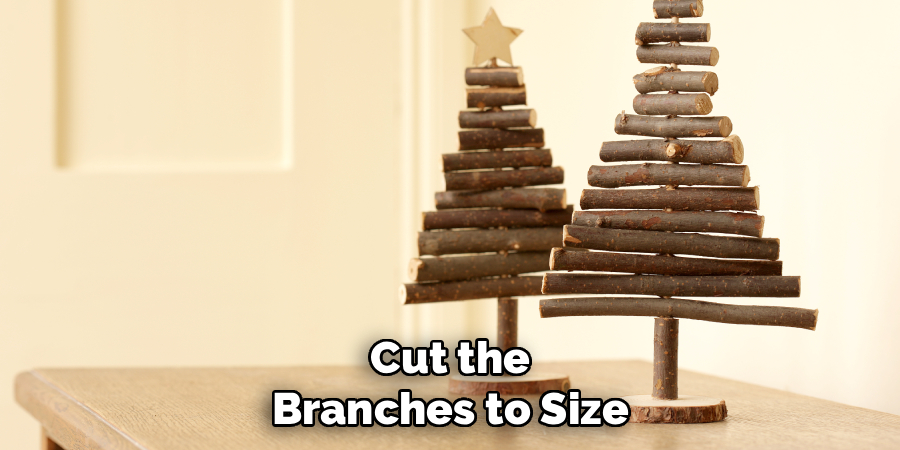
Step 2: Cut the Branches to Size
With your measurements marked, it’s time to cut the branches. Safety should be your top priority during this step. Put on your safety glasses to protect your eyes from sawdust and wood chips. If you are using a miter saw, ensure you are familiar with its operation. Set the saw to a 0-degree angle for straight, perpendicular cuts. Place the 1×4 board firmly against the saw’s fence and align the blade with your first pencil mark. Make a clean, steady cut.
Repeat this process for all ten branch pieces. If you are using a hand saw and a miter box, secure the wood in the box and use the guides to ensure your cuts are straight. A hand saw will require more physical effort, so take breaks as needed to avoid fatigue. Once all ten branches are cut, you can arrange them on the floor in order of size, from largest to smallest, to get a preview of your tree’s shape.
Step 3: Prepare the Spacers
To create space between the branches and allow them to pivot, you will need to cut small spacer blocks from the 1×2-inch board. These spacers will sit on the central dowel between each branch, providing separation and visual interest. A standard height for each spacer is about 1.5 inches. Since you have ten branches, you will need nine spacers to go between them, plus one for the very bottom to lift the first branch off the base. So, you need to cut a total of ten spacer blocks.
Using your tape measure and pencil, mark ten 1.5-inch sections on your 1×2 board. Just as you did with the branches, use your miter saw or hand saw to cut these small blocks. Precision is important, as you want all the spacers to be identical in height. This uniformity will ensure that your branches are evenly spaced, giving the tree a professional and polished look.
Step 4: Find and Mark the Center Point
Now you need to find the exact center of each branch and each spacer block. This is where the dowel will pass through, acting as the tree’s trunk. For the branches, take your tape measure and find the midpoint of the length of each piece. For example, on the 24-inch branch, the center is at the 12-inch mark. Mark this point with a pencil. Then, find the center of the board’s width (a 1×4 is actually 3.5 inches wide, so the center is at 1.75 inches). The intersection of these two lines is the precise center.
Repeat this for all ten branches. For the spacer blocks, the process is similar but simpler. Since they are small squares or rectangles (likely 1.5 inches by 1.5 inches), finding the center is straightforward. Draw two diagonal lines from corner to corner; the point where they cross is the exact center.
Step 5: Drill the Holes
This is a critical step that requires a steady hand. You will be drilling a hole through the center mark on every branch and every spacer. The hole needs to be the same diameter as your wooden dowel, which is 1/2 inch in this guide. Secure your first branch to your workbench using clamps. This prevents the wood from moving while you drill, ensuring a clean and accurately placed hole. Attach a 1/2 inch drill bit to your drill.
Position the tip of the drill bit directly on the center mark you made. Hold the drill perfectly perpendicular to the wood surface to ensure the hole goes straight through. Apply steady, even pressure and drill all the way through the branch. Repeat this process for the remaining nine branches and all ten spacer blocks.
Step 6: Create the Base
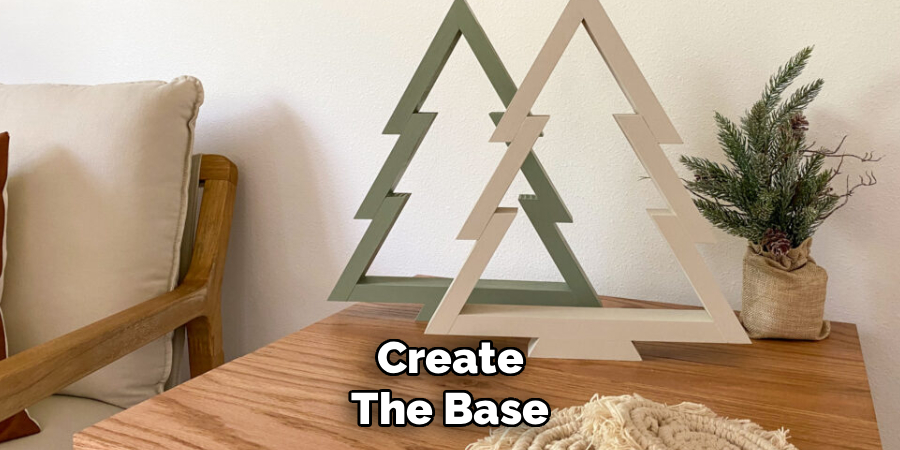
Your tree needs a stable base to stand upright. For this, you will use a small wooden block, such as a 4×4 piece. The base needs a hole to hold the central dowel securely. This hole should not go all the way through the block. This is called a “blind hole.” Find the center of your base block just as you did with the other pieces. Mark the center point clearly.
To control the depth of the hole, you can use a piece of tape. Measure about 2 inches up from the tip of your 1/2 inch drill bit and wrap a piece of painter’s tape around it. This will act as a visual stop guide. Secure the base block firmly in a clamp or vise. Drill down into the center of the block until the tape on your drill bit reaches the surface of the wood.
Step 7: Sand Everything Smooth
For a professional finish and to prevent splinters, you must sand every wooden component. This step may seem tedious, but it makes a huge difference in the final quality of your project. Start with medium-grit sandpaper (around 120-grit) to smooth out any rough edges or saw marks on the branches and spacers. Pay special attention to the corners and the edges of the drilled holes.
Once you have gone over every piece with the medium-grit paper, switch to a fine-grit sandpaper (around 220-grit). This will give the wood a silky-smooth finish, preparing it perfectly for paint or stain. Run your hands over the surfaces to feel for any remaining rough spots. Don’t forget to lightly sand the dowel as well.
Step 8: Apply Your Finish
Now it’s time to add some color and protection to your tree. You have several options here, depending on the look you want to achieve. You could use a wood stain to enhance the natural grain of the timber for a rustic feel. Or, you could paint the tree a classic green, a modern white, or any color that matches your holiday decor. A clear sealer is another option if you simply want to protect the wood while keeping its natural color.
Apply your chosen finish in a well-ventilated area, and lay down a drop cloth to protect your workspace. If painting or staining, apply a thin, even coat to all sides of each branch and spacer. Use a paintbrush for larger surfaces and a smaller artist’s brush for edges and hard-to-reach areas. Allow the first coat to dry completely according to the manufacturer’s instructions.
Step 9: Assemble Your Tree
This is the most exciting part, where your project finally comes together. Start with the base, which should now have the dowel securely glued in place and pointing upwards. Take your first spacer block and slide it down the dowel until it rests on the base. Next, take your largest branch (the 24-inch one) and slide it down the dowel onto the spacer. Then, add another spacer.
Continue this pattern—spacer, branch, spacer, branch—working your way up from the largest branch to the smallest. Each branch should be separated by a spacer. This stacking process creates the tree’s structure. As you add each piece, you can give it a slight turn to stagger the branches, creating a more dynamic, spiral look. Or, you can align them perfectly for a more symmetrical appearance.
Step 10: Add the Final Touches
Your wooden Christmas tree is now assembled, but the final touches will truly make it your own. If you have a wooden star or another lightweight tree topper, you can affix it to the top. A small hole drilled into the top of the dowel or a bit of strong wood glue can secure it in place. Now, it’s time to decorate. You can wrap delicate fairy lights around the branches, hang small, lightweight ornaments, or even string some simple garland.
The beauty of this design is its versatility. You can fan the branches out to create a full-looking tree or swivel them into a flat, two-dimensional profile to save space. Place your new tree on a mantelpiece, a side table, or as a centerpiece for your holiday dining table.

Conclusion
Building your own wooden Christmas tree is more than just a craft project; it’s an opportunity to create lasting holiday memories. With a few basic tools and a little bit of patience, you can construct a beautiful, modern decoration that reflects your personal style.
Hopefully, this article on how to make wooden christmas trees has inspired you to get creative and try your hand at making your own wooden Christmas tree.
This guide has provided you with all the steps, but feel free to add your own creative flair. Enjoy the process, and may your handcrafted tree be a source of pride and joy throughout the festive season.

About
Mike May is a distinguished figure in the world of woodworking and timber design, with a decade of expertise creating innovative and sustainable indoor solutions. His professional focus lies in merging traditional craftsmanship with modern manufacturing techniques, fostering designs that are both practical and environmentally conscious. As the author of Woodimber, Mike delves into the art and science of timber-craft, inspiring artisans and industry professionals alike.
Education
RMIT University (Melbourne, Australia)
-
Associate Degree in Design (Timber): Focus on sustainable design, industry-driven projects, and practical craftsmanship.
-
Gained hands-on experience with traditional and digital manufacturing tools, such as CAD and CNC software.
Nottingham Trent University (United Kingdom)
-
Bachelor’s in Woodworking and Product Design (Honors): Specialized in product design with a focus on blending creativity with production techniques.
-
Participated in industry projects, working with companies like John Lewis and Vitsoe to gain real-world insights.
Publications and Impact
In Woodimber, May shares his insights on timber design processes, materials, and strategies for efficient production. His writing bridges the gap between artisan knowledge and modern industry needs, making it a must-read for both budding designers and seasoned professionals.